




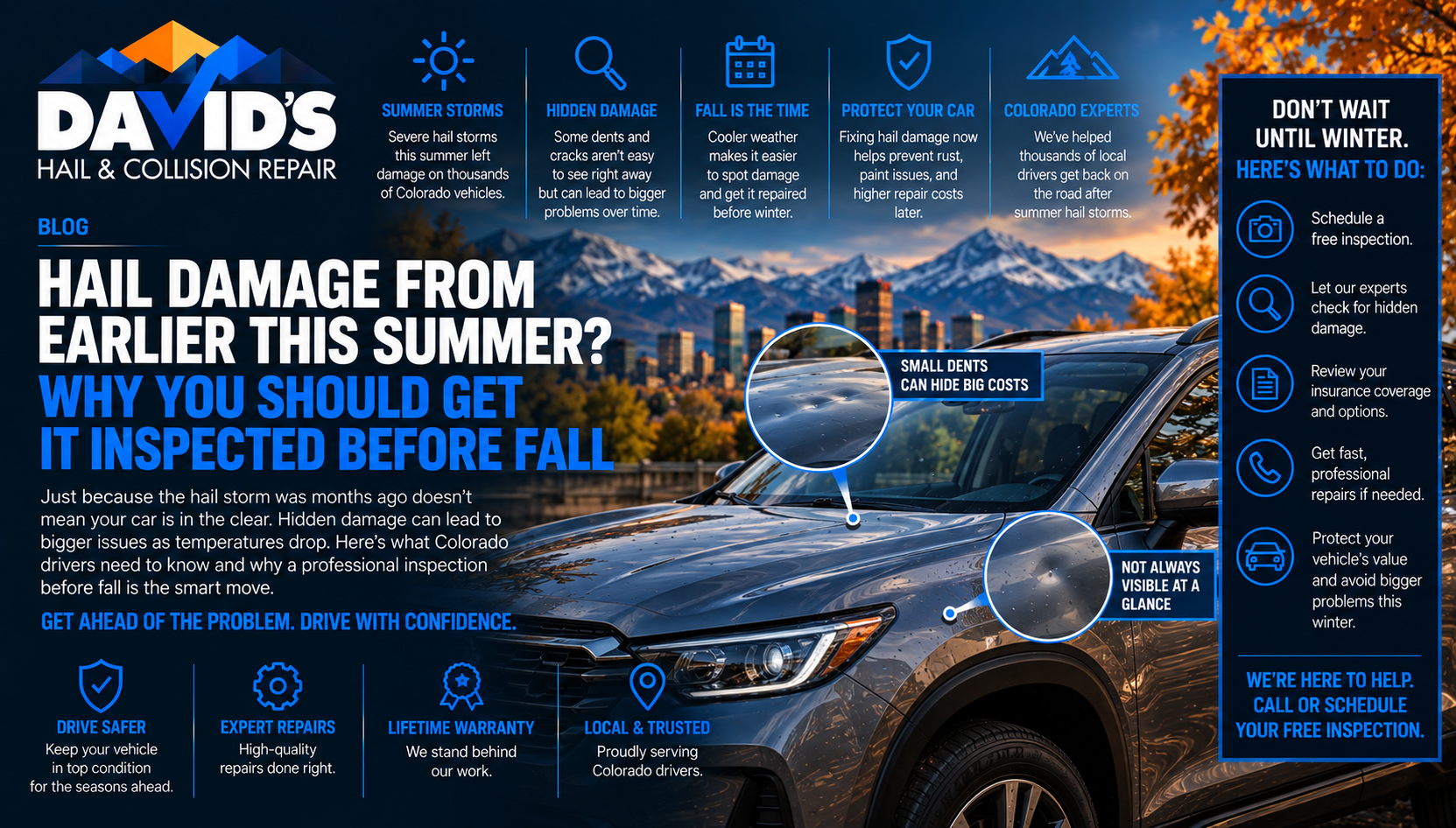
Hail Damage From Earlier This Summer? Why You Should Get It Inspected Before Fall
Colorado’s summer hail season can be relentless.
If your vehicle was caught in a hailstorm earlier this summer, you may have noticed a few dents and decided to deal with them later. Your car still runs normally, the damage may not look severe, and there always seems to be something more urgent to handle.
But as summer begins winding down, now is a good time to take another look at that hail damage.
Waiting until fall or winter doesn’t make the dents disappear, and putting off an inspection can create unnecessary complications—especially if another storm damages the vehicle or you eventually decide to file an insurance claim.
If your car was hit by hail earlier this summer, here are several reasons to have the damage professionally inspected before fall.
You May Have More Hail Damage Than You Realize
One of the biggest reasons to schedule an inspection is simple: hail damage can be difficult to see.
You might notice several dents on the hood while completely overlooking damage on the roof, trunk, doors, fenders or roof rails.
Professional hail technicians use specialized lighting and reflection systems that make subtle dents much easier to identify.
During an inspection, technicians can determine:
- Which panels were damaged
- Approximately how many dents are present
- The size and severity of the dents
- Whether the factory paint remains intact
- Whether Paintless Dent Repair may be appropriate
- Whether any areas require conventional body repair
Instead of guessing based on what you can see in your driveway, you’ll know the actual extent of the damage.
Summer Hail Damage Is Easy to Put Off
Unlike many collision-related problems, hail damage doesn’t usually prevent you from driving the vehicle.
There’s no flat tire. The engine still runs. The steering feels normal.
That makes hail damage easy to ignore.
Weeks can pass before you realize the dents have been there for most of the summer.
The problem with waiting isn’t necessarily that every hail dent will suddenly become dramatically worse. The bigger issue is that delaying the inspection can make documentation, insurance claims and future damage more complicated.
Getting the vehicle inspected now gives you a clear record of its current condition.
Another Hailstorm Can Complicate Existing Damage
Colorado’s hail season doesn’t necessarily end after one major storm.
If your vehicle gets caught in another hailstorm before the existing damage is repaired, the same panels may sustain additional dents.
That can make separating old damage from new damage more difficult.
If insurance claims are involved, two different storms may potentially represent two different dates of loss and two separate claims, depending on the circumstances and your insurance policy.
Having existing damage inspected and documented before another storm occurs can provide a much clearer picture of your vehicle’s condition.
Don’t Wait Until You Need to Sell or Trade the Vehicle
Hail damage may be cosmetic, but cosmetic condition matters when it’s time to sell or trade a vehicle.
A dealership or private buyer is likely to notice visible dents, especially when the vehicle is inspected under good lighting.
Waiting until you’re ready to trade the vehicle can put you in a position where you’re suddenly trying to arrange repairs while also shopping for your next vehicle.
Addressing the damage earlier gives you more control over the timing.
It also allows you to understand the repair cost and available options well before you’re negotiating the value of your vehicle.
Fall and Winter Won’t Make Existing Dents Disappear
It’s easy to think about hail damage as a summer problem.
Once Colorado’s storm season begins winding down, many drivers simply stop thinking about it.
But the damage remains.
Cold temperatures themselves don’t automatically mean every hail dent will suddenly become severe. However, delaying the repair through another season provides no real benefit.
If the paint was damaged during the hailstorm, exposed or compromised areas may also require additional attention to protect the panel.
A professional inspection can determine whether you’re dealing with straightforward PDR damage or something that needs conventional repair.
Can Paintless Dent Repair Fix Summer Hail Damage?
In many cases, yes.
Paintless Dent Repair (PDR) is often the preferred method for repairing hail dents when the vehicle’s factory paint remains intact and the metal can be successfully restored.
PDR technicians use specialized tools to carefully manipulate the damaged metal back toward its original shape.
Because the process doesn’t require traditional sanding, body filler and repainting when PDR is appropriate, the vehicle can retain its original factory finish.
Whether a dent qualifies for PDR depends on factors including:
- Dent size
- Dent depth
- Location
- Metal condition
- Paint condition
- Accessibility behind the panel
- Amount of metal stretching
The fact that the hailstorm happened several months ago doesn’t automatically prevent the damage from being repaired with PDR.
The condition of the damage matters more than the date on the calendar.
What If Some of the Damage Can’t Be Repaired With PDR?
Not every hail-damaged panel is necessarily a PDR candidate.
Larger or sharper impacts can stretch the metal or damage the paint. Certain panel locations may also make Paintless Dent Repair impractical.
In those situations, conventional collision repair may be necessary.
That’s one advantage of choosing a repair facility that handles both Paintless Dent Repair and conventional collision repair.
The appropriate repair method can be selected based on the actual damage instead of trying to force every dent into the same repair process.
What If You Haven’t Filed an Insurance Claim Yet?
If the hailstorm happened earlier this summer and you haven’t reported the damage, don’t automatically assume you’ve waited too long.
Insurance policies vary, and there isn’t one reporting deadline that applies to every Colorado auto policy.
However, policies commonly contain requirements regarding when losses should be reported.
Waiting longer can also make it more difficult to establish exactly when and where the damage occurred, particularly if your vehicle has been exposed to multiple storms.
If you’re considering filing a claim, review your policy and contact your insurance company for information about your specific coverage and reporting requirements.
A professional hail damage inspection can also help you understand the extent of the damage before moving forward.
What If You Already Have an Insurance Estimate?
If you’ve already filed a claim and received an insurance estimate but haven’t scheduled the repair, bring the estimate with you when you visit the repair shop.
The initial insurance estimate may not always include every dent or repair procedure ultimately identified during a thorough inspection.
When additional covered damage or necessary repair operations are discovered, the repair facility can document them and submit a supplement to the insurance company for consideration.
David’s Hail & Collision Repair can work directly with your insurance carrier throughout the repair process, helping make the experience easier from inspection through completed repairs.
Your insurance carrier ultimately determines coverage according to your individual policy.
Why Late Summer Is a Good Time to Get Your Vehicle Inspected
If you’ve been saying, “I’ll deal with it later,” August is a good time to turn later into now.
A late-summer hail inspection allows you to:
- Determine the full extent of the damage
- Document your vehicle’s current condition
- Find out whether PDR is appropriate
- Understand your repair options
- Address insurance questions
- Avoid carrying unresolved damage into fall and winter
- Get ahead of potential additional storm damage
An inspection doesn’t mean you’re committing to a repair.
It simply gives you the information needed to decide what makes sense for your vehicle.
Hail Damage Repair in Englewood and the Denver Metro Area
David’s Hail & Collision Repair provides professional hail damage repair and Paintless Dent Repair from our Englewood location.
We serve vehicle owners throughout Englewood, Denver, Aurora, Lakewood, Littleton and surrounding Denver Metro communities.
Our team can thoroughly inspect your vehicle, identify damage that may be difficult to see, determine whether PDR is appropriate and explain your repair options.
When insurance is involved, we can also assist with the claims and repair process and communicate directly with your insurance carrier.
David’s Hail & Collision Repair offers free hail damage inspections, deductible assistance of up to $500 on qualifying repairs, and a lifetime warranty on our repair work.
Schedule Your Free Hail Damage Inspection Before Fall
If your vehicle was damaged by hail earlier this summer, don’t let another season pass without finding out exactly how much damage it sustained.
You may have more hail damage than you can see, and getting it inspected now can make planning the repair much easier.
Schedule a free hail damage inspection with David’s Hail & Collision Repair today. We’ll inspect your vehicle, explain what we find and help you understand your repair and insurance options before fall arrives.