




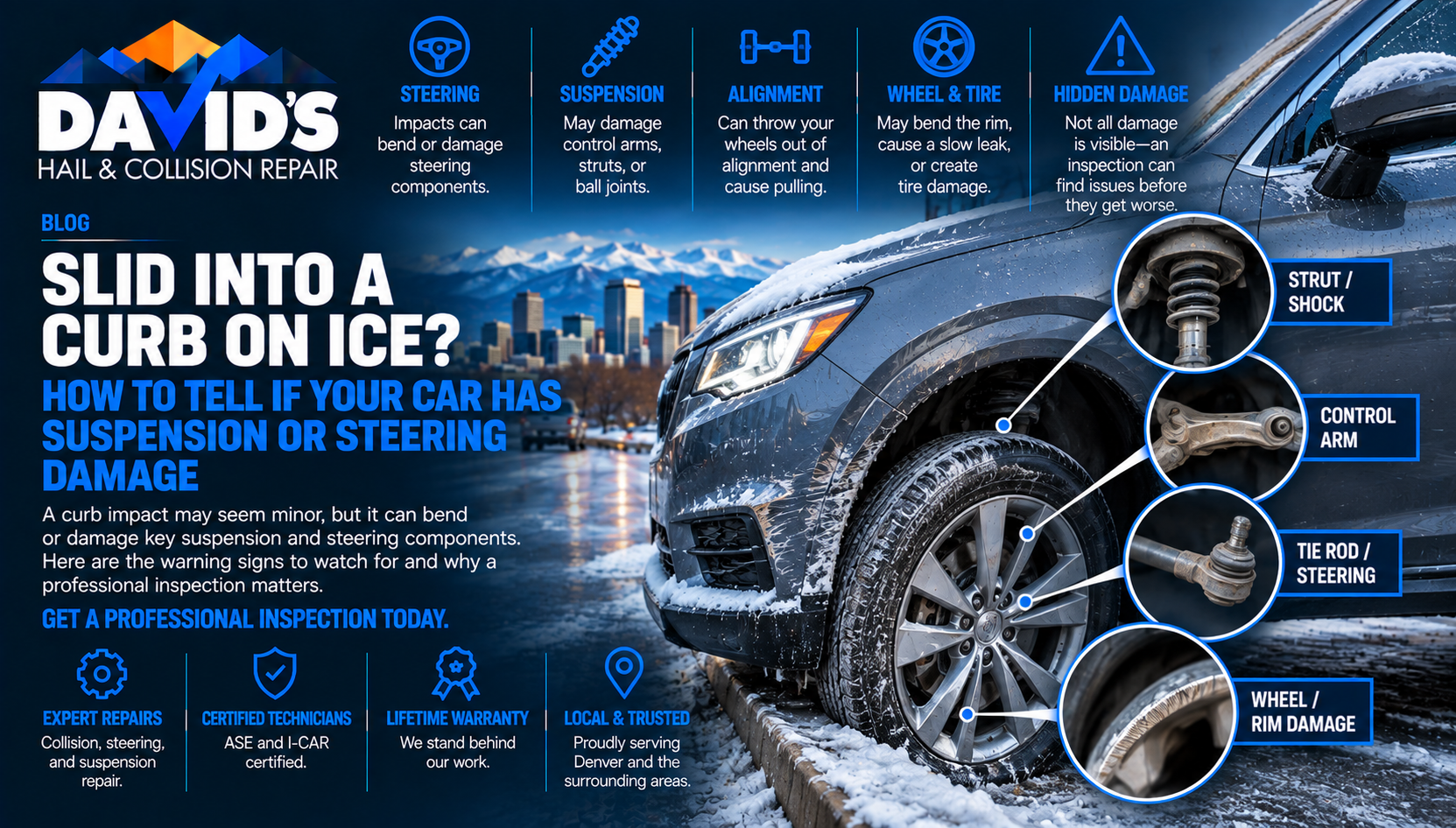
Slid Into a Curb on Ice? How to Tell If Your Car Has Suspension or Steering Damage
Colorado winters can turn an ordinary corner into an expensive accident. You tap the brakes, turn the steering wheel, and suddenly your vehicle slides across an icy road and slams into a curb.
You get out, look at the wheel, and everything seems relatively normal. Maybe there’s a scuff on the rim or a small mark on the tire. You drive away thinking you got lucky.
But hitting a curb on ice can cause suspension, steering, wheel, and alignment damage that isn’t immediately visible. Even a low-speed impact can bend components underneath your vehicle and affect how it handles.
At David’s Hail & Collision Repair, we help Denver-area drivers identify accident-related damage and determine the appropriate repairs before minor-looking problems become bigger concerns.
Here’s what to look for after sliding into a curb—and why a wheel alignment alone might not be enough.
Can Hitting a Curb Damage Your Suspension?
Yes. Hitting a curb can bend or damage suspension and steering components, including control arms, tie rods, struts, ball joints, and wheel assemblies. Damage can occur even when the tire and wheel appear relatively normal.
Your suspension is designed to absorb road imperfections and maintain proper tire contact with the pavement. It isn’t designed to absorb every sideways impact against a concrete curb.
When a tire strikes a curb, the force travels through the wheel and into the components connecting it to the vehicle.
Depending on the impact, damage may affect:
- Control arms
- Tie rods and steering linkages
- Ball joints
- Struts and shock absorbers
- Wheel bearings and hubs
- Wheels and tires
- Suspension mounting points
- Steering knuckles
- Subframes and related components
The severity depends on vehicle speed, impact angle, wheel position, and the vehicle’s suspension design.
1. Your Steering Wheel Is Crooked After Hitting the Curb
One of the first warning signs of possible damage is a steering wheel that no longer sits straight when the vehicle is traveling in a straight line.
For example, you might notice that you have to hold the steering wheel slightly to the left to keep the car moving straight.
This can indicate that the impact changed the vehicle’s wheel alignment.
However, a crooked steering wheel doesn’t automatically mean the problem can be corrected with an alignment.
A bent tie rod, control arm, steering knuckle, or other damaged component may need to be repaired or replaced before proper alignment can be restored.
If the steering wheel suddenly changes position after striking a curb, have the vehicle inspected before continuing normal driving.
2. Your Car Pulls to One Side
If your vehicle begins drifting left or right after hitting a curb, something may have changed in the steering, suspension, tire, or wheel assembly.
Possible causes include:
- Incorrect wheel alignment
- Bent suspension components
- Damaged steering linkages
- Tire damage
- Wheel damage
- Changes in suspension geometry
A vehicle that pulls to one side can be more difficult to control, especially on snow-covered roads where traction is already limited.
It’s important to identify the underlying cause instead of assuming the vehicle only needs an alignment.
3. You Notice Vibrations While Driving
A new vibration after striking a curb is another warning sign.
You may feel it through the steering wheel, floor, or seat, particularly as your speed increases.
Possible causes include:
- Bent wheel
- Damaged tire
- Wheel imbalance caused by the impact
- Damaged wheel hub
- Suspension component damage
- Other wheel or steering problems
Even a relatively small bend in a wheel can produce noticeable vibration at highway speeds.
If the impact caused a tire bulge, cut, or other structural tire damage, continued driving may increase the risk of tire failure.
Don’t ignore a new vibration simply because the vehicle still moves normally at lower speeds.
4. Your Tire or Wheel Looks Damaged
After sliding into a curb, inspect the wheel and tire from a safe location.
Look for:
- Cracks in the wheel
- Bent rim edges
- Sidewall cuts
- Bulges in the tire
- Rapid or gradual air loss
- Uneven gaps around the wheel
- A tire that appears tilted or out of position
Some wheel damage is obvious, but other problems can be difficult to identify without removing the wheel or inspecting the suspension.
A tire sidewall bulge is particularly concerning because it can indicate internal structural damage.
If you see a bulge, significant cut, cracked wheel, or rapid air loss, don’t continue driving on that wheel.
5. You Hear Clunking, Grinding, or Clicking Noises
Your vehicle shouldn’t suddenly develop new suspension or steering noises after a curb impact.
Pay attention to sounds when:
- Turning the steering wheel
- Driving over bumps
- Accelerating
- Braking
- Entering or leaving a driveway
- Traveling at low speeds
Clunking may indicate a loose or damaged suspension component.
Grinding can suggest wheel, brake, or bearing-related problems.
Clicking or popping while turning can indicate problems involving steering or suspension joints, although other mechanical issues can produce similar symptoms.
The sound alone isn’t enough to diagnose the damage, but it’s an important reason to schedule an inspection.
6. Your Vehicle Sits Unevenly
Take a look at your vehicle while it’s parked on reasonably level ground.
Does one corner appear lower than the others?
Does one wheel seem farther forward or backward within the wheel opening?
Does the tire appear tilted compared with the wheel on the opposite side?
These differences can indicate suspension or structural damage.
A hard curb impact may bend a control arm or affect mounting points, changing the position of the wheel.
In more severe cases, the impact can damage components attached to the vehicle’s subframe.
These problems require more than a routine wheel alignment.
7. Your Tires Start Wearing Unevenly
Not every curb-related problem becomes obvious immediately.
Sometimes the vehicle seems to drive normally after the accident, but the tires begin wearing unevenly over the following weeks.
Watch for:
- Excessive wear on the inside edge
- Excessive wear on the outside edge
- Feathered tread patterns
- Unusual tire noise
- Changes in steering response
Improper alignment can accelerate tire wear and shorten the life of otherwise good tires.
However, tire wear can also result from damaged suspension components, incorrect tire pressure, or other mechanical issues.
A professional inspection can help identify the cause before additional tire damage occurs.
Is It Safe to Drive After Hitting a Curb?
It may be safe to move a vehicle after a minor curb impact, but you shouldn’t assume it’s safe for normal driving until potential damage has been evaluated.
The risk depends on the force of the impact and whether critical components were affected.
Avoid driving and arrange towing or professional assistance if you notice:
- A flat tire or damaged tire sidewall
- A cracked or severely bent wheel
- Significant steering changes
- A wheel visibly out of position
- Grinding or severe clunking
- Fluid leaking near the wheel or underneath the vehicle
- A tire rubbing against the body
- The vehicle becoming difficult to control
Even when none of these symptoms appears, a hard curb strike can justify an inspection because some damage isn’t obvious from outside the vehicle.
Does Hitting a Curb Always Mean You Need an Alignment?
No. Not every curb impact causes damage, and not every damaged vehicle needs only an alignment.
An alignment adjusts wheel angles to the vehicle manufacturer’s specifications.
But if a component is bent, broken, or displaced, adjusting alignment settings may not solve the problem.
For example, a bent control arm can prevent the wheel from reaching the correct alignment specifications.
The proper sequence is generally:
- Inspect the wheel and tire.
- Evaluate the steering and suspension components.
- Identify damaged or bent parts.
- Repair or replace affected components as necessary.
- Perform an alignment when required.
- Verify proper vehicle operation.
An alignment should not be used to compensate for damaged suspension components.
Can a Curb Impact Cause Hidden Structural Damage?
Yes, particularly when the impact is severe or involves a wheel striking the curb at an unfavorable angle.
Suspension components connect to mounting points on the vehicle’s structure or subframe.
A significant impact can transfer force beyond the wheel assembly.
Depending on the vehicle, technicians may need to evaluate:
- Suspension mounting locations
- Subframe alignment
- Steering rack mounting areas
- Wheel-well components
- Underbody components
- Nearby structural areas
This is why a thorough inspection matters after a hard impact.
The visible condition of the tire doesn’t necessarily reveal what happened to the components behind it.
Will Car Insurance Cover Damage From Hitting a Curb?
Damage from accidentally striking a curb may be covered under collision insurance, depending on your policy, deductible, and the circumstances of the accident.
For example, if your vehicle slides on ice and strikes a concrete curb, the resulting impact damage is generally the type of loss evaluated under collision coverage rather than comprehensive coverage.
However, coverage isn’t automatic.
Your insurance company determines whether the loss is covered under your specific policy.
Before filing a claim, consider the potential repair cost, deductible, and policy terms.
If you decide to proceed with an insurance repair, David’s Hail & Collision Repair can help document accident-related damage and coordinate repair information with your insurance carrier.
Learn more about our Insurance Claims Assistance services.
What If the Insurance Estimate Misses Suspension Damage?
An initial insurance estimate may focus on visible damage to the wheel, tire, or exterior body panels.
But additional damage may become apparent during a more detailed inspection.
For example, a vehicle might initially appear to need a replacement wheel and tire, but further evaluation could reveal a bent control arm or damaged steering component.
When legitimate accident-related damage is identified that wasn’t included in the original estimate, the repair facility can document the findings and submit a supplemental estimate to the insurance carrier for review.
The insurance company then evaluates the additional repair information according to the claim and policy.
Why Colorado Winter Curb Accidents Deserve Extra Attention
Denver-area drivers deal with a combination of snow, ice, freezing temperatures, and rapidly changing road conditions.
A road that looks wet during the afternoon can become icy after temperatures drop.
Intersections, parking lots, bridges, and shaded streets can become particularly slippery.
When a vehicle loses traction, the driver may have little control over the direction or angle of impact.
A sideways strike against a curb can place substantial force on components that weren’t designed to absorb that type of collision.
And if the steering or suspension has been damaged, the next snowstorm can make an already compromised vehicle more difficult to control.
That’s why addressing possible damage promptly is important.
What Should You Do After Sliding Into a Curb?
If your vehicle strikes a curb on an icy road, follow these steps.
1. Get to a Safe Location
If the vehicle can be moved safely, get away from active traffic.
Avoid standing near moving vehicles or on an icy roadway while inspecting the damage.
2. Check the Wheel and Tire
Look for obvious tire damage, bent rims, air loss, and a wheel that appears out of position.
Don’t drive on a visibly damaged tire or wheel.
3. Pay Attention to Handling Changes
If it’s safe to move the vehicle, notice whether the steering wheel is crooked, the vehicle pulls, or unusual noises occur.
Do not perform a high-speed test drive to check for damage.
4. Document the Incident
Take photographs of the wheel, tire, surrounding body panels, and visible damage.
If an insurance claim is involved, this documentation may be useful.
5. Schedule a Professional Inspection
A qualified repair facility can determine whether the impact affected the wheel, steering, suspension, or surrounding components.
6. Repair the Damage Before It Gets Worse
Driving with damaged steering or suspension components can create additional safety concerns and contribute to premature tire wear.
Addressing the problem early can help prevent further damage.
Professional Collision Repair for Denver Drivers
At David’s Hail & Collision Repair, we understand that winter accidents don’t always leave obvious damage.
A vehicle that slides into a curb may need more than a new tire or routine alignment.
Our team can evaluate visible collision damage and help coordinate the appropriate inspection and repair of accident-related components.
David’s offers:
- ASE and I-CAR certified technicians
- Professional collision and auto body repair
- Damage inspections
- Structural and body repair
- Insurance claims assistance
- Insurance supplement coordination
- Up to $500 in deductible assistance on qualifying repairs
- Limited lifetime warranty on qualifying repairs
- A+ Better Business Bureau rating
- English and Spanish-speaking customer assistance
For specialized steering, suspension, or alignment work, the required procedures should be completed by appropriately equipped technicians or specialists.
Learn more about our Collision Repair services.
Serving Denver, Englewood, and Surrounding Communities
David’s Hail & Collision Repair is located in Englewood, Colorado, and serves drivers throughout the Denver metro area, including Denver, Aurora, Lakewood, Littleton, Centennial, and Highlands Ranch.
Whether your vehicle slid into a curb at an icy intersection, hit a concrete parking barrier, or struck a curb while turning on a snow-covered street, don’t assume the damage is limited to what you can see.
Schedule Your Free Winter Collision Damage Inspection
A curb impact that looks minor can leave expensive damage hidden behind your wheel.
If your vehicle has been involved in an icy-road accident, David’s Hail & Collision Repair can inspect the visible damage, explain the next steps, and help coordinate the repair process.
Call (303) 815-3854 or schedule your free inspection online.